

Share Links: Distribute Mobile Builds to External Testers, Clients, and Stakeholders
You have a build ready for testing. Your internal team uses TestApp.io for daily testing. they install builds through the mobile app, get push notifications, and submit feedback. But now a client wants to see the latest version. A freelance QA contractor needs access for a week. Your marketing team wants to demo the app at a trade show.
These people don't need full accounts. They don't need access to your task board or activity feed. They just need to install the build on their phone and try it.
That's what share links solve.
What Share Links Actually Do
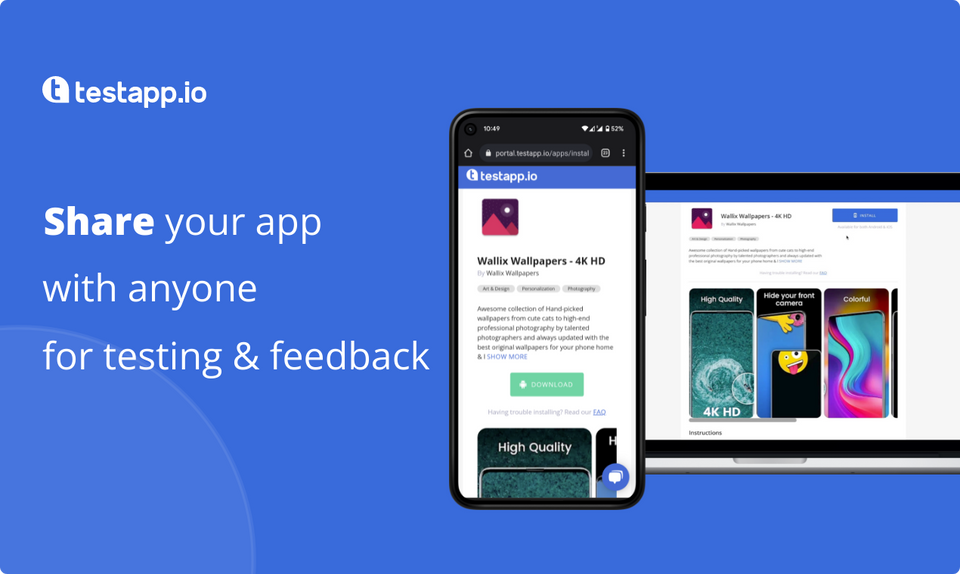
A share link is a public install page for your app. You send someone a URL, they open it on their phone, and they install the build. No TestApp.io account required. No app store review. No SDK to integrate.
Each share link is a standalone landing page that adapts to the visitor's device:
- Android phone. Shows an install button and release details (version, size, permissions). Tester taps install and the APK downloads directly.
- iPhone or iPad. Shows the iOS install option. If the IPA was built with an enterprise provisioning profile, it installs directly. Otherwise, you can link to your TestFlight build for external testers.
- Desktop. Shows a QR code. The tester scans it with their phone and lands on the same page.
The page also shows your app icon, description, and any install instructions you've added. It looks like a proper app landing page, not a download link in a Slack thread.
Creating a Share Link
In the TestApp.io portal, go to your app's settings and open the Share Links section. The creation wizard walks you through four steps:
Step 1: Android Release
Choose which Android build appears on the share link:
- Skip, No Android build on this link (iOS only).
- Specific release. Pin to a particular APK version.
- Latest (auto-update). Always points to the newest Android release. When you upload a new build, the link updates automatically.
Step 2: iOS Release
iOS distribution on share links has an important constraint: direct IPA install requires an enterprise provisioning profile. If your team uses ad-hoc provisioning (which ties installs to registered UDIDs), external testers won't be able to install directly because their devices aren't on your provisioning profile.
Your options:
- Skip, No iOS build on this link (Android only).
- Specific release. Pin to a particular IPA. Only works if built with an enterprise provisioning profile.
- TestFlight. Link to your TestFlight public link. This is the best option for non-enterprise iOS distribution. supports up to 10,000 external testers without UDID collection.
- Latest (auto-update). Always points to the newest iOS release. Requires an enterprise provisioning profile for direct install.
Step 3: Page Content
Add context for the person opening the link:
- Install instructions (login credentials for the test environment, specific test scenarios to try)
- Release notes (what changed in this build)
- Contact info (who to reach out to with questions)
This is especially useful for client-facing links where you want the experience to feel professional, not just "here's a raw download."
Step 4: Security and Limits
This is where share links go from "convenient download link" to "controlled distribution channel":
- Password protection. Require a password before the install page loads. Useful for confidential builds shared with clients under NDA.
- Expiration. Set the link to expire after 1 to 30 days, or leave it with no expiration. Time-limited links work well for demo builds and contract testers.
- Install limit. Cap the total number of installs. Once the limit is reached, the link stops working. Set to unlimited for no cap.
Multiple Links per App
You can create as many share links as you want for the same app. This is where the feature gets practical for real workflows:
- Client demo link. Pinned to a stable release, password-protected, no expiration. You send this once and update the underlying build when ready.
- QA contractor link. Auto-updates to latest, expires in 30 days, limited installs. The contractor gets fresh builds automatically for the duration of the engagement.
- Trade show link. QR code on your booth display, pinned to the demo version, expires after the event.
- Stakeholder review link. Points to a specific release candidate, password-protected. Stakeholders install and sign off before you go to production.
Each link has its own settings, analytics, and status. they're independent of each other.
Link Status and Control
Every share link has a status you can change:
- Active. Testers can install normally.
- Coming Soon. Shows a custom message while your app isn't ready yet.
- Maintenance Mode. Temporarily pauses installs with a message (useful during backend changes).
- Disabled. Stops all installs on this link.
You don't have to delete a link and recreate it. Just toggle the status.
Tracking Who's Installing
Each share link has its own analytics:
- Views. How many times the install page was loaded, broken down by device type and location.
- Installs. How many times builds were downloaded, broken down by device and release version.
- Trends. Views and installs over time, so you can see when testers are active.
This tells you things like: "The client opened the link 12 times but only installed once" (they may be having trouble with the install) or "The QA contractor installed 3 different builds this week" (they're actively testing).
Internal Team vs. External Testers
Share links are for external distribution. For your internal team, TestApp.io has a different path:
- Internal team. Team members sign in to the TestApp.io mobile app (iOS / Android) or the portal. They get push notifications for new builds, install with a tap, work through assigned tasks, and submit feedback with screenshots and videos.
- External testers. Clients, stakeholders, and contractors use share links. No account, no app to install. Just open the URL and install the build.
You can use both at the same time. Your team tests through the mobile app while your client reviews through a share link. Both workflows feed into the same project, so you see all feedback and activity in one place.
Getting Started
If you already have a TestApp.io workspace and an uploaded build:
- Go to your app's Settings → Share Links
- Click Create Share Link
- Walk through the 4-step wizard
- Copy the URL and send it to your tester
The whole thing takes under a minute. For the full setup guide with screenshots, see Share Links in the help center.
If you haven't set up your workspace yet, create one free and upload your first build. You can create share links immediately after your first release.
Ship Mobile Apps Faster with TestApp.io
TestApp.io helps mobile teams distribute builds to testers, collect feedback, and manage releases, all in one place. Support for iOS (IPA) and Android (APK), with integrations for Slack, Microsoft Teams, Jira, Linear, and 10+ CI/CD platforms.
👉 Get started free, or explore the Help Center to learn more.